Celebrating the Azhwars and the Divya Desams of Lord Sriman Narayana!

Wednesday, June 15, 2011

Thiru Ninra Ur Divya Desam


One of the seven Divya Desams in and around Chennai.

[Click here for photos of this Divya Desam]

Location and Access:

The temple is located in ThiruninravUr, which is one of the stations on the Chennai-ArakkONam suburban train line. This station is approximately 35 km from Chennai Central station and the train journey takes about an hour. The temple is about 15-20 minutes by walk from ThiruninravUr station. Auto-rickshaws (tuk-tuks) are also available from the station to the temple.

The temple:

The temple is not very large and if not crowded, all sannidhis can be covered in less than 45 minutes. In this Divya Desam, we find the motherly love of the Divya Dampathi exhibited in ample measure – the thAyAr here is known as “ennai petra thAyAr” (literally, the Mother who gave birth to me) and the perumAL here is Sri Bhaktavatsala perumAL (He who has motherly love towards His devotees). Another name for thAyAr is Sri SudhA vaLLi. The temple has two prakArams and a five storied Raja gOpuram.

Legends and History:

Legend has it that VaruNA worshipped the Lord at this Divya Desam.
According to www.templenet.com, the temple has stone inscriptions dating back to the period of King Nandivarma Pallava (~500 AD) and rAjarAja chOzhA III (~1250 AD)

AzhwAr mangaLAsAsanams:

Sri Tirumangai AzhwAr 1089,1642

(pAsuram numbers are according to the number listed in any standard 4000 Divya prabandham book)

According to legend, Sri Tirumangai AzhwAr visited this Divya Desam but left without singing any pAsurams about the place. The perumAL from this Divya Desam followed AzhwAr all the way to the Divya Desam of Thiru kadal mallai (Mahabalipuram) and finally got AzhwAr to mention ThiruninravUr in his pasurams.

Sri ennai petra thAyAr samEtha Sri Bhakthavatsala perumAL thiruvadigaLaE saraNam.

Sunday, May 1, 2011

ThiruvallikENi Divya dEsam (aka Triplicane in Chennai city)


ThiruvallikENi is a compact, impeccably maintained Divya Desam located in the heart of Chennai city. Chennai is the largest metropolis in South India, and is very well connected by land and air.

Location and Access:

Triplicane is about 5 km from Chennai’s main railway station (Chennai Central) and about 15 km from Chennai’s international airport. Triplicane is well connected by public transport from all parts of Chennai and its suburbs – although public transport can get pretty crowded during peak hours. It is also perfectly possible to take a call-taxi or auto from any part of Chennai to Triplicane. The temple is locally referred to as “Parthasarathy Koil”.

Legends and History:

This is probably the only Divya Desam whose name is derived from the temple tank (pushkariNi). The word “alli-kENi” literally means lily-pond. The theertham is also known as “kairavini-saras”.

The incarnation of Sri Ramanuja is attributed to the Grace of the perumAL here. Sri Asuri KesavAchArya and his wife prayed at this temple seeking progeny. Their prayers were answered resoundingly with the birth of Sri Ramanuja.

The mUlavar here goes by the name of Sri vEnkatakrishnan. The uthsavar is known as Sri pArthasArathy (literally means Arjuna’s charioteer). The uthsavar’s face bears numerous scars, that reflect the injuries caused by Bhishma’s arrows during the course of the great mahAbhAratha war, when Lord Krishna directed ArjunA’s chariot. Lord Krishna intercepted most of the arrows directed towards His devotee ArjunA, saving the latter from certain destruction. The mUlavar here is tall and supremely imposing, with His Consort standing at His right. On His left, we see sAtyaki, who was His beloved friend and confidant during the KrishnAvataram. Also, seen standing along with them are Sri BalarAma, Krishna’s brother, and Sri Pradyumna and Sri Aniruddha. The idols of Sri Pradyumna and Aniruddha are at one side of the sanctum sanctorum and may not be seen easily.

A very unique feature of the mUlavar here is His prominent moustache, which is painted in white on His divine face. This imparts a rather stern look to His visage. On certain occasions, the moustache is removed. I have had the privilege of seeing Him without the moustache, and found that He assumes a very kind, mischievous, youthful (almost boyish) look without it – indicative of His Infinite soulabhyam.

The Temple:

As we enter the temple, there is a large stone mandapam. As we proceed further, we see the dhwaja-sthambam (flagstaff). To the right, there is a fairly large stone mandapam. At one corner of the mandapam, there is a kannAdi-arai (Mirror-room) where Sri pArthasArathy often gives darshan with His ubhaya nAchiyArs. Also in this mandapam is a sannidhi for Sri garudAzhwAr directly facing Sri perumAL. As we cross this mandapam, there is a partially open corridor. As we proceed clockwise in this corridor, we first see the sannidhi of Sri vEdavaLLi thAyAr with a mandapam in front. As we proceed further, there is a small sannidhi for Sri gajEndra varadhan. As we proceed further clockwise, there is a sannidhi for Sri yOga narasimhA, who is known as “TheLLiya-singar” (the serene lion). The uthsavar of Sri narasimhar is of ineffable beauty. Then we see a sannidhi for Sri ANDAL, and as we proceed further clockwise, we arrive at the sannidhi of Sri pArthasArathy. On the way to this sannidhi, there are smaller sannidhis for Sri vaishnava AchAryas. Also, there are separate sannidhis for Sri rAmA (accompanied by His brother and His Consort) and Sri RanganAthA.

The temple is not very big, and if it is not crowded, all sannidhis can be covered in a little over an hour. However, the temple can get crowded in the evenings and on weekends – especially Saturdays.

The ambience:

A unique feature about this Divya Desam is the ambience of the area around the temple. Even though the area is now congested and teeming with apartments, still there is a certain old-world charm that pervades the area, which can never be described adequately. It can only be experienced. The uthsavar Sri pArthasArathy often comes out in procession on the streets, eager to mingle with His devotees. Whenever He does so, it is an enthralling sight. In terms of rituals, uthsavams and alankAram for PerumAl, this temple ranks at the very top among Divya Desams. Often, it is common to see a bunch of young kids following perumAl during uthsavams, with a miniature procession of their own, complete with vAhanams and full alankAram for Sri PerumAl.

AzhwAr mangaLAsAsanams:

Sri Tirumangai AzhwAr 1068-77
Sri pEyAzhwAr 2297
Sri TirumazhisaiAzhwAr 2416
(pAsuram numbers are according to the number listed in any standard 4000 Divya prabandham book)

A sample pAsuram:

பரதனும் தம்பி சத்ருக் கனனும்
லக்கும நோடு மை திலியும்
இரவும் நன் பகலும் துதிசெய்ய நின்ற
ராவணாந்தகனை எம்மானை
குரவமே கமழும் குளிர்பொழி லூடு
குயிலோடு மயில்கள் நின்றால
இரவியின் கதிர்கள் நுழைதல் செய் தறியாத்
திருவல்லி கேணிக் கண்டேனே

In this pAsuram SrI Tirumangai AzhwAr says that he beheld the terminator of rAvaNA, Sri rAmA – who is worshipped day and night by His brothers BharathA, SathrugNA and lakshmaNA and His Consort Sri Mythili – at TiruvallikENi. AzhwAr further describes this Divya dEsam as one teeming with cuckoo birds and peacocks, and filled with dense green forestry – so dense that it is impossible for sunrays to penetrate through the canopy of trees.

The TiruvallikENi of today is far removed from how it was in the days of Sri Tirumangai AzhwAr (~8th century AD). Today’s TiruvallikENi is a concrete jungle with hardly any trees- not to speak of cuckoo birds and peacocks. However, the place still retains a devotional ambience.

SrI vEdavaLLi thAyAr samEtha SrI pArthasArathy perumAL thiruvadigaLaE saraNam

Monday, February 28, 2011

VeLi (Outer) ANDAL sannidhi at Sri Rangam


This is a very beautiful sannidhi for Sri Andal, located at #9, Mela Adayavalanjaan Street, Sri Rangam, very close to the Ranganatha temple. According to local history, when Sri PeriAzhwar and Andal arrived at Sri Rangam from Srivilliputhur, they stayed at a house before visiting the temple (and Andal merged with Lord Ranganatha). This house became the veLi ANDAL sannidhi. As always, the image of Sri ANDAL here is very beautiful. She is verily the embodiment of the Lord's trait of forgiveness.

(Correspondingly, there is another sannidhi for ANDAL within the temple of Lord Ranganatha, called the uLL (Inner) ANDAL sannidhi)

The beauty of Sri Rangam is that it has plenty of places and temples and small sannidhis that are associated with the lives of AchAryas. Also, the place is connected with several historical events.

Saturday, February 19, 2011

Our Travel to Sri Mukthinath (Salagramam) Divya Desam


First of all, thanks and prayers to the Divya Dampathi and our Acharyas, whose grace made this trip happen. It was undoubtedly their krupa that helped us have a safe and successful trip overcoming several hurdles.

Sincere thanks and respects to Sri Mukund (NAMA Singapore) for his blessings and guidance – based on his past travels to Mukthinath. He has been instrumental in making this trip happen.

Special thanks to Sri KaLai (Ramanuja Dasan) who has been the chief planner and coordinator for this trip. His arrangements were meticulous, and enabled all of us to have a wonderful trip with memories that will stay forever.

Thanks to Sri Sudhir and Sri Srikanth, for their support and presence that made the trip a truly enjoyable and devotional experience. And how can I forget to mention Sri Mugunthan, who made the trip lively and engaging with no shortage of humour and cheer!

[Link to photos of the trip]

We landed in Katmandu around noon on Feb 13 and after completing our arrival formalities, were met at Tribhuvan International Airport by our designated driver – Shyam Lama. The weather was pleasant and we drove through Katmandu to the office of Samrat Travel, where we met our travel agent Rajaram. Sri Kalai had previously worked out our travel plan with Rajaram and we collected our air tickets for flying within Nepal and our Government permit for travelling through the Annapoorna Trail. Although we did not do any trekking on this formidable trail, we still needed the permit to pass through Jomsom town en route to Mukthinath. Katmandu is located at an altitude of about 1400 m above sea level and is a crowded city with small roads and a lot of traffic. We did not see any tall buildings or apartments – Katmandu still seems to have only individual houses.

[External Link for information on Katmandu]

From our travel agent’s office, we proceeded to have a late lunch at Aangan Restaurant and then started our journey to the town of Pokhara by van. This town is located at an altitude of about 800 m above sea level and is 200 km from Katmandu. We reached around 10 pm after a six hour journey. In between we stopped a couple of times for hot tea – which was most welcome in the cool weather.

Pokhara is home to Lake Phewa, and is close to the base of the formidable Annapurna mountain range. It is a rather relaxed and unpolluted place compared to Katmandu. We stayed at Hotel Landmark, where the only inconvenience was that we did not get really hot water for our bath next morning. We got a packed breakfast of aaloo parathas and started off next morning to Pokhara Airport to take our flight to the town of Jomsom. Our plane was a small twin engined one with a capacity of about 20 passengers. The local airlines in Nepal have names like Sita Air, Agni Air, Buddha Air, etc etc. Our flight to Jomsom took about 25 minutes. We got a very spectacular view of huge snow-capped peaks. This region is home to several tall peaks like the Dhaulagiri, Annapurna, Manaslu and Macchapuchre. Mother Nature flexing her muscles!

[External Link for information on Pokhara]

Jomsom is a very small town (perhaps settlement is a better word) located at an altitude of 2800 m above sea level. Upon landing at Jomsom, we could immediately feel the effect of the altitude. The weather was much colder than Pokhara and we immediately had to put our winter clothing (winter jacket, gloves, head cap, muffler, moisturiser etc) to full use. We left our bigger pieces of luggage at Hotel Majesty and packed a few essentials into smaller bags and left for Mukthinath by jeep.

Mukthinath is located at an altitude of 3800 metres and is about 1.5 hours by jeep from Jomsom. The journey is beautiful and takes us along River KaliGandaki. This is the same as the sacred Gandaki River in whose bed Salagramam stones can be naturally found. Salagramam stones, as is well-known, are manifestations of Lord Sriman Narayana. As the Himalayan mountains started to form and rise above the sea, the Gandaki river slowly cut its way through the mountains forming a valley. Our journey took us along a part of this valley. The path to Mukthinath is a very rough trail and not a proper road. We stopped in the middle to take photos. It is also possible to make the journey from Jomsom to Mukthinath by pony or by walk. By walk, it can take several hours and is a very arduous journey.

We reached Mukthinath at around 2 PM and went to Sri Mukthinath lodge where some of us had lunch. Mukthinath is a very small mountain village with a few hotels and a few houses. The houses are built on highly uneven terrain with mud walls and have a pile of wood on the roof for insulation. It is common to find solar water kettles here. The temperature was around zero degrees even in the afternoon. Since it was February, there was hardly any crowd in the town. March is a rather crowded period, since the temperature is more conducive. There are a few roadside stalls from where local handicrafts and Salagramams can be obtained.

We left our luggage at the hotel and started off to our most important destination – the temple of Sri Mukthinath, one of the 108 Sri Vaishnava Divya Desams glorified by the Azhwars! From our hotel we could choose to walk uphill for about 20 minutes to reach the temple, or we could choose to be driven on a motorbike. Either way, the path is steep and can be difficult for people with acrophobia (fear of heights).

At the Divya Desam, there was not much of a crowd. At the entrance to the Divya Desam, we bought a few pictures of Sri Mukthinath. There were about 4-5 visitors apart from us, and they left presently. The temple is very small compared to the Divya Desams of Tamil Nadu and the style of construction is also totally different. Around the temple, there are 108 water-spouts –representing the theerthams of the 108 Divya Desams. A few of us chose to do snanam here, braving the sub-zero temperatures. After this, we entered the temple and first worshipped Sri Ramanuja and Sri Andal in a small, separate sannidhi. We chanted thaniyans and submitted our offerings to Sri Ramanuja and Sri Andal. After obtaining their blessings, we went to the main sannidhi where we offered worship to Sri Salagramam Udaiya Nambi (as PeriAzhwar addresses Him) who is accompanied by Sri Lakshmi and Sri Bhoo Devi. It was a most wonderful and auspicious darshan. Sri Perumal has a very benevolent expression on His face. Adiyen will describe the temple in greater detail in a separate posting in this blog. The sannidhi is maintained by Buddhist nuns. Also, we met a Nepali Sri Vaishnava priest who also does araadhanam at the temple. After our worship at the temple, this Sri Vaishnava priest was kind enough to explain the sthala-puranam of Sri Salagramam in detail.

After a very unhurried and thorough darshan at the temple, we walked down to our hotel. It was around 4.30 PM and had already started growing dark. It was at this point that we really started feeling the adverse effects of the high altitude and the cold weather. Altitude sickness affected all of us. A couple of us vomited and we had difficulty breathing as oxygen was scarce. None of us felt like having any food or drink. We did not have any heating in our rooms and we had to keep one of the windows open to maintain our oxygen supply. So in effect, we had to spend the night exposed to the atmosphere. It snowed through the night and temperatures were around -10 degrees Celsius. It was a most difficult experience. Our hotel owner gave us tablets to counter the altitude sickness. These provided some relief. We had to sleep (or rather, try to sleep) under very thick blankets to shield us from the biting cold. It was a very difficult night. Thanks to the Grace of the Divya Dampathi, we survived. The next morning, a few of us went uphill again to have a second darshan of Sri Mukthinath. Also, the Sri Vaishnava priest at the temple gave us several Salagramams. At around 11 AM, we started off back to Jomsom by jeep. En route, we stopped to have contact with the sacred water of the Gandaki river.

At Jomsom, we went straight to Hotel Majesty and had a nice lunch (soup, sandwiches, rasam – yes, the hotel was able to provide our South Indian rasam!, aloo parathas etc.). We warmed ourselves on coal stoves. After lunch, a few of us took a jeep ride to the village of Marpha, where we bought fresh apple juice from a local factory. Then we had an early dinner and went to bed at around 8.30 PM. A night of solid sleep gave us rest and recuperation from our mountain sickness. We got up at 5.30 AM to catch our flight to Pokhara at 6.30 AM. We found that it had snowed heavily through the night and our flight was cancelled. We spent the morning waiting for information and trying to make a decision on what to do next. We also used the time to visit a local museum that had a lot of information about the geography and origins of the region. Finally we decided to get moving and got a jeep to take us to the village of Ghaasa. We heard that, just before Ghaasa, there was a roadblock and we had to alight and shift our luggage across the roadblock and then take another jeep to Ghaasa. From Ghaasa, we had to take another jeep to Beni, from where our agent would arrange for our travel to Pokhara. We started with this plan in mind. However, en route to Ghaasa, our vehicle sunk into the mud and stalled. We were stuck in the middle of nowhere! Along with Sri Srikanth, our driver went to get help from a nearby village. As the rest of us were waiting, a van came by and the driver managed to skilfully negotiate the road where our vehicle was stuck and got to the other side. When Sri Srikanth came back, we all got into the other vehicle and reached the point where the road was blocked. Here, we moved our luggage through a very tricky mountain slope to cross the roadblock. Sri Srikanth played a key role in guiding us through the path and also in carrying most of the heavy luggage.

At the other side of the roadblock, we had a van waiting to take us to Ghaasa. From Ghaasa, we chartered a jeep to take us to Beni. The journey from Ghaasa to Beni took about 3 hours, and our driver had to negotiate very tricky slopes and narrow paths. In the moonlight, we could see the beauty of River Gandaki making its way through the mountains. We reached Beni at 11 PM, and were met by our driver who took us to our hotel in Pokhara at around 2 PM. We got up at around 8.30 AM and had a good breakfast and did a little shopping. Sri Sudhir and Sri Kalai found a very knowledgeable supplier of Salagramams at Pokhara.

Later in the morning, we took a flight back to Katmandu and checked into Hotel Manang at around 2 PM. After unpacking, we started off to the temple of Sri Budha Nilakanth, which has a beautiful vigraham of Lord Sriman Narayana lying on Adiseshan. After offering worship here, we did a little bit of shopping before heading off to dinner. After dinner, we got back to our hotel and woke up the next morning at 5.30 AM. We drove straight to the temple of Chaangu Narayanan (Champaka Narayanan) which is situated on a small hill outside Katmandu. We had an excellent darshan early in the morning with a wonderful view of the sunrise. The vigraham of Sri Garudazhwar outside the Perumal Sannidhi here is very beautiful. After a very satisfying darshan, we visited a nearby museum which housed relics and coins from ancient Nepal. Then, we dropped off Sri Srikanth at the airport for him to catch his flight to Delhi and proceeded to our hotel for breakfast. Then we packed and made our way to the airport again to take our return flight out of Nepal. It was a great trip!

Based on our experience, here is a list of items to carry during the trip:
  1. Full winter gear – heavy winter jacket, sweater(s), scarf, woolen head-cap that also covers ears, woolen socks, thermal innerwear, heavy winter shoes, heavy gloves
  2. Torch – Very important as power cuts are regular in Nepal.
  3. Tablets for high-altitude sickness (very important)
  4. Basic medicines – for cold, fever, antibiotics, anti-diarrheal, antiseptic, bandages, painkillers
  5. Lip moisturizer (like Vaseline), face moisturizing cream
  6. Ready to eat foodstuff – energy bars, biscuits, nuts (almonds)
  7. Electronics: Digital camera + batteries/chargers, mobile phone + charger. The electric power plug design in Nepal is the same as in India
  8. Basics: Passport, cash/cards, List of emergency contacts, insurance papers (Indian citizens don’t need a passport to enter Nepal, but some form of identification like PAN card/ration card is needed)
  9. Religious items: Thiruman and Srichoornam, Containers/bags for bringing Sri Saligramam moorthys
  10. Miscellaneous items: Soap, cosmetics, detergent, plastic bags, cloth-hangers for drying.
Azhwar Emperumaanaar Jeeyar ThiruvadigaLae SaraNam
ThirumAl thiruvadigaLae saraNam

Sunday, February 6, 2011

Thiru Uraiyur a.k.a ThirukkOzhi


Located within Tiruchirapalli city in central Tamil Nadu, India, this temple is one of the 108 Sri Vaishnava Divya Desams and also the birthplace of Sri ThiruppAn AzhwAr, one of the twelve AzhwArs.

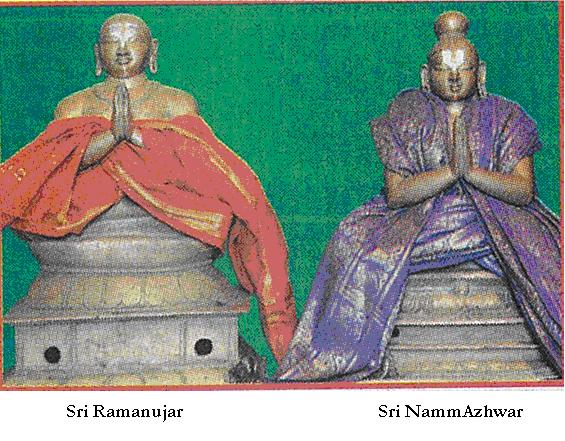
A very compact temple, it houses separate sannidhis for Sri ThiruppAn AzhwAr, Sri NammAzhwAr, Sri VishvaksEnar and Sri Raamanujar.

Access:
Since Uraiyur is part of Tiruchirapalli (Trichy for short) city, it is easily accessible. The name ThirukkOzhi is virtually unheard of today, and the place is referred to as Uraiyur or Nachiyar Koil by local people. Visitors may stay at Trichy and cover Uraiyur along with other Divya Desams in and around Trichy, which include Sri Rangam, Thiruvellarai, Uthamar Koil, Thiru Anbil and Koviladai (aka Thiruppaer Nagar). From within Trichy city, Uraiyur can be reached by public transport buses or auto. Those who wish to cover all the six Divya Desams in and around Trichy can hire call-taxis and cover all the Divya Desams in 1-2 days.

The temple:
As we enter the temple, there is a stone mandapam (hall). To the left, there is a corridor that houses the sannidhis for Sri ThiruppAn AzhwAr, Sri NammAzhwAr, Sri VishvaksEnar and Sri Raamanujar. On the left of this corridor, there is a very beautiful, deep stone tank that is completely housed within the temple campus. It is a very serene sight when the tank is full. An entrance in the corridor on the right hand side, leads us to the main sannidhi. The main sannidhi (sanctum sanctorum) has the Perumal Sri Azhagiya Manavalan in a very beautiful standing posture, with the Thayar Sri Kamalavalli seated on the left. There is no separate sannidhi for ThAyAr. There is no Utsavar idol for Perumal here, just a Utsavar for ThAyAr.
Behind the main sannidhi, there is a nandhavanam (flower garden) with a vasantha mandapam.

The temple is not very big and all sannidhis can be covered in about 45 minutes. Those who wish to enjoy this place in leisure can take a slow walk around the corridor and observe the beauty of the temple, tank, the stone pillars, the beautiful paintings in the smaller sannidhis, the flower garden, and above all, the infinitely auspicious beauty of the Divya Dampathi. Sri Thiruppaan Azhwar showers his gentle benevolence on devotees, guiding them towards the Divya Dampathi.

Legends and History:
Sri Kamalavalli Thayar is said to have incarnated as the daughter of the local Chozha king and later married Sri Perumal. The Chozha king built the temple to commemorate the divine wedding. Hence Perumal is known as Azhagiya MaNavALan which literally means “The handsome bridegroom”. On the day preceding Pankuni Uthiram, the uthsavar of Sri Ranganatha (NamperumAL) is brought from Sri Rangam and a Kalyana Uthsavam is celebrated with the Thayar here. Since ThayAr has a lot of importance here, the temple is referred to as “nAchiyAr koil” by local people.

Historically, Uraiyur was the capital of the Chozha kings at one point of time. Later the Chozhas shifted their capital to Pazhaiyarai near Kumbakonam and then later to Thanjavur.

Thirumangai Azhwar and Kulasekara Azhwar have glorified this Divya Desam.

Sri KamalavaLLi ThAyar samEtha Sri Azhagiya MaNavALa PerumAL ThiruvadigaLAE saraNam
Sri ThiruppAN AzhwAr ThiruvadigaLAE saraNam

Sunday, September 19, 2010

Thiruvelliyangudi

Very comprehensive information on this Divya Desam at these websites:

http://www.templenet.com/Tamilnadu/df022.html

http://kolavilliramar.blogspot.com/

Saturday, September 18, 2010

Thiruppaer Nagar (aka Koviladi, Appakudathaan)


(Acknowledgement: All images in this posting on Thiruppaer Nagar are from Kumudham Jothidam magazine. A wonderful article on this Divya Desam by the renowned astrologer Sri A M Rajagopal was published in the issue dated July 16 2010)

Click here for a beautiful Youtube video of this Divya dEsam.

Tiruchirappalli (Trichy) in central Tamilnadu was the former capital of the glorious Chola kingdom. Situated right on the banks of the River Kaveri, Trichy is a bustling, lively city surrounded by vast tracts of lush green fields. The region in and around Trichy is dotted with several hallowed Divya Desams, with the foremost Divya Desam – Sri Rangam, being just across the Kaveri from Trichy. Uraiyur, another Divya Desam and also the birthplace of Sri Thiruppaan Azhwar is located within Trichy city.

Thiru Anbil, Uttamar Koil (Thiru-karambanUr), Thiru Vellarai, Koviladi (formal name Thiruppaer Nagar) are the other major Divya Desams around Trichy city. It is possible to cover all the six Divya Desams in and around Trichy in one day by road, although covering them over two days is more convenient and leisurely. Personally, I avoid rushing through Divya Desams. It is better to cover them sedately, enjoying the sights and sounds, absorbing the holy vibrations and imbibing the devotion and spirit of the Azhwars who elevated the temples to Divya Desam status through their devotional verses (mangaLaasAsanam). From a practical point of view, Trichy is well connected by road, rail and air (there are direct flights from Singapore and Columbo) and has plenty of hotels Food options are abundant.


Of the Divya Desams in and around Trichy, the one that can safely take the top honours for beauty of location is Thiruppaer Nagar (unofficially referred to as Koviladi or Appakudathaan). Koviladi is situated directly on the banks of the KoLLidam river, which is a tributary of the River kAvEri. Further, this place is near the Grand Anaicut dam. The Grand Anaicut was built in the 2nd century AD by the Cholas, and is still in excellent shape and continues to be used even today. When the British governed India, a team of engineers was deputed to study this dam and identify any improvements or reinforcements that might be needed. The engineers concluded that there was nothing needed to strengthen or modify the dam – a testimony to the technical calibre of the Chola engineers.

Getting back to kOviladi, the Divya Desam is built at a high elevation (about 50 feet from the ground). The reason is immediately obvious when we consider that the koLLidam river is less than 200 feet away. This is also the reason why the temple has survived intact over the centuries despite the ever-present threat of flooding.

Legend associated with Koviladi:

According to the sthala puranam, a king Upamanyu lost his wealth and kingdom due to a curse from Sage Durvasa. He begged the sage himself to suggest a way to be freed of the curse. Moved by his entreaty, the sage prescribed that Upamanyu do an anna-dhaanam (distribution of food) at this place. Accordingly, the king started this act of penance. One day, an old man arrived at Upamanyu’s place to accept food and was received with respect. But, to Upamanyu’s dismay and surprise, the old man quickly gobbled off all the food that the king had on hand. When he explained the situation to his elderly guest, the latter asked for a pot of “appam” – a kind of sweet pancake. Upamanyu arranged for it, and upon receiving it, the old man revealed his true identity – He was none other than Lord Sriman Narayana. Upamanyu was delighted and freed of Durvasa’s curse. Hence the Lord of Koviladi got the moniker “Appakudathaan”, which means “He who has a pot of appam”. True to this name, the moolavar in the Divya Desam has His right hand holding a pot of appam. In deference to the legend of Upamanyu, appam is prepared for the Lord every night as prasadam. According to this Divya Desam’s history, kOviladi even pre-dates Sri Rangam in antiquity.

Further, Thiruppaer Nagar is the Divya Desam where Lord Sriman Narayana removed the fear of death from Sage mArkandEyA’s mind. The theertham here is referred to as “Mruthyu vinaasini theertham”.

Thiruppaer Nagar is one of the five Ranga-Kshetrams. The full list is :

1. Adhi-Rangam: Sri-Rangapatnam near Mysore, Karnataka
2. appAla-Rangam: Thiruppaer Nagar
3. madhya-Rangam: Sri-Rangam
4. chaturtha-Rangam: Thirukkudanthai (Kumbakonam)
5. pancha-Rangam: Thiru-indhalUr (near MayilAduthurai)

AzhwAr mangaLAsasanams (33 pAsurams):

PeriyAzhwar: 173, 205
Thirumangai Azhwar: 1428-37, 1851, 1857, 2048, 2050, 2059, 2060, 2070, 2673 (70), 2674 (118)
Thirumazhisai Azhwar: 2417
NammAzhwar: 3744-54

This is the last Divya Desam glorified by Sri Nammazhwar before his ascent to paramapadam.

The thAyar here is Sri KamalavaLLi, who is seated in a separate sannidhi and bestows Her infinitely compassionate glances on Her devotees.

Location:

Koviladi is about 25 km from Trichy city and about 8 km from the Grand Anaicut. Those who wish to travel by bus may first take a bus to kallaNai (Grand Anaicut) from Trichy’s Chathram bus terminus and then take a bus (from Kallanai) travelling in the direction of Thanjavur or Kumbakonam and alight at kOviladi.