Celebrating the Azhwars and the Divya Desams of Lord Sriman Narayana!

Sunday, February 6, 2011

Thiru Uraiyur a.k.a ThirukkOzhi


Located within Tiruchirapalli city in central Tamil Nadu, India, this temple is one of the 108 Sri Vaishnava Divya Desams and also the birthplace of Sri ThiruppAn AzhwAr, one of the twelve AzhwArs.

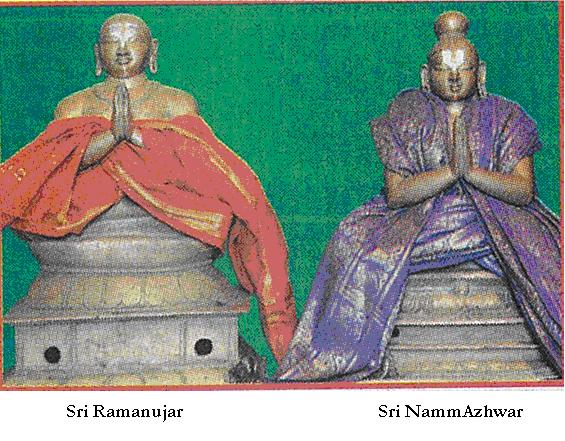
A very compact temple, it houses separate sannidhis for Sri ThiruppAn AzhwAr, Sri NammAzhwAr, Sri VishvaksEnar and Sri Raamanujar.

Access:
Since Uraiyur is part of Tiruchirapalli (Trichy for short) city, it is easily accessible. The name ThirukkOzhi is virtually unheard of today, and the place is referred to as Uraiyur or Nachiyar Koil by local people. Visitors may stay at Trichy and cover Uraiyur along with other Divya Desams in and around Trichy, which include Sri Rangam, Thiruvellarai, Uthamar Koil, Thiru Anbil and Koviladai (aka Thiruppaer Nagar). From within Trichy city, Uraiyur can be reached by public transport buses or auto. Those who wish to cover all the six Divya Desams in and around Trichy can hire call-taxis and cover all the Divya Desams in 1-2 days.

The temple:
As we enter the temple, there is a stone mandapam (hall). To the left, there is a corridor that houses the sannidhis for Sri ThiruppAn AzhwAr, Sri NammAzhwAr, Sri VishvaksEnar and Sri Raamanujar. On the left of this corridor, there is a very beautiful, deep stone tank that is completely housed within the temple campus. It is a very serene sight when the tank is full. An entrance in the corridor on the right hand side, leads us to the main sannidhi. The main sannidhi (sanctum sanctorum) has the Perumal Sri Azhagiya Manavalan in a very beautiful standing posture, with the Thayar Sri Kamalavalli seated on the left. There is no separate sannidhi for ThAyAr. There is no Utsavar idol for Perumal here, just a Utsavar for ThAyAr.
Behind the main sannidhi, there is a nandhavanam (flower garden) with a vasantha mandapam.

The temple is not very big and all sannidhis can be covered in about 45 minutes. Those who wish to enjoy this place in leisure can take a slow walk around the corridor and observe the beauty of the temple, tank, the stone pillars, the beautiful paintings in the smaller sannidhis, the flower garden, and above all, the infinitely auspicious beauty of the Divya Dampathi. Sri Thiruppaan Azhwar showers his gentle benevolence on devotees, guiding them towards the Divya Dampathi.

Legends and History:
Sri Kamalavalli Thayar is said to have incarnated as the daughter of the local Chozha king and later married Sri Perumal. The Chozha king built the temple to commemorate the divine wedding. Hence Perumal is known as Azhagiya MaNavALan which literally means “The handsome bridegroom”. On the day preceding Pankuni Uthiram, the uthsavar of Sri Ranganatha (NamperumAL) is brought from Sri Rangam and a Kalyana Uthsavam is celebrated with the Thayar here. Since ThayAr has a lot of importance here, the temple is referred to as “nAchiyAr koil” by local people.

Historically, Uraiyur was the capital of the Chozha kings at one point of time. Later the Chozhas shifted their capital to Pazhaiyarai near Kumbakonam and then later to Thanjavur.

Thirumangai Azhwar and Kulasekara Azhwar have glorified this Divya Desam.

Sri KamalavaLLi ThAyar samEtha Sri Azhagiya MaNavALa PerumAL ThiruvadigaLAE saraNam
Sri ThiruppAN AzhwAr ThiruvadigaLAE saraNam

Sunday, September 19, 2010

Thiruvelliyangudi

Very comprehensive information on this Divya Desam at these websites:

http://www.templenet.com/Tamilnadu/df022.html

http://kolavilliramar.blogspot.com/

Saturday, September 18, 2010

Thiruppaer Nagar (aka Koviladi, Appakudathaan)


(Acknowledgement: All images in this posting on Thiruppaer Nagar are from Kumudham Jothidam magazine. A wonderful article on this Divya Desam by the renowned astrologer Sri A M Rajagopal was published in the issue dated July 16 2010)

Click here for a beautiful Youtube video of this Divya dEsam.

Tiruchirappalli (Trichy) in central Tamilnadu was the former capital of the glorious Chola kingdom. Situated right on the banks of the River Kaveri, Trichy is a bustling, lively city surrounded by vast tracts of lush green fields. The region in and around Trichy is dotted with several hallowed Divya Desams, with the foremost Divya Desam – Sri Rangam, being just across the Kaveri from Trichy. Uraiyur, another Divya Desam and also the birthplace of Sri Thiruppaan Azhwar is located within Trichy city.

Thiru Anbil, Uttamar Koil (Thiru-karambanUr), Thiru Vellarai, Koviladi (formal name Thiruppaer Nagar) are the other major Divya Desams around Trichy city. It is possible to cover all the six Divya Desams in and around Trichy in one day by road, although covering them over two days is more convenient and leisurely. Personally, I avoid rushing through Divya Desams. It is better to cover them sedately, enjoying the sights and sounds, absorbing the holy vibrations and imbibing the devotion and spirit of the Azhwars who elevated the temples to Divya Desam status through their devotional verses (mangaLaasAsanam). From a practical point of view, Trichy is well connected by road, rail and air (there are direct flights from Singapore and Columbo) and has plenty of hotels Food options are abundant.


Of the Divya Desams in and around Trichy, the one that can safely take the top honours for beauty of location is Thiruppaer Nagar (unofficially referred to as Koviladi or Appakudathaan). Koviladi is situated directly on the banks of the KoLLidam river, which is a tributary of the River kAvEri. Further, this place is near the Grand Anaicut dam. The Grand Anaicut was built in the 2nd century AD by the Cholas, and is still in excellent shape and continues to be used even today. When the British governed India, a team of engineers was deputed to study this dam and identify any improvements or reinforcements that might be needed. The engineers concluded that there was nothing needed to strengthen or modify the dam – a testimony to the technical calibre of the Chola engineers.

Getting back to kOviladi, the Divya Desam is built at a high elevation (about 50 feet from the ground). The reason is immediately obvious when we consider that the koLLidam river is less than 200 feet away. This is also the reason why the temple has survived intact over the centuries despite the ever-present threat of flooding.

Legend associated with Koviladi:

According to the sthala puranam, a king Upamanyu lost his wealth and kingdom due to a curse from Sage Durvasa. He begged the sage himself to suggest a way to be freed of the curse. Moved by his entreaty, the sage prescribed that Upamanyu do an anna-dhaanam (distribution of food) at this place. Accordingly, the king started this act of penance. One day, an old man arrived at Upamanyu’s place to accept food and was received with respect. But, to Upamanyu’s dismay and surprise, the old man quickly gobbled off all the food that the king had on hand. When he explained the situation to his elderly guest, the latter asked for a pot of “appam” – a kind of sweet pancake. Upamanyu arranged for it, and upon receiving it, the old man revealed his true identity – He was none other than Lord Sriman Narayana. Upamanyu was delighted and freed of Durvasa’s curse. Hence the Lord of Koviladi got the moniker “Appakudathaan”, which means “He who has a pot of appam”. True to this name, the moolavar in the Divya Desam has His right hand holding a pot of appam. In deference to the legend of Upamanyu, appam is prepared for the Lord every night as prasadam. According to this Divya Desam’s history, kOviladi even pre-dates Sri Rangam in antiquity.

Further, Thiruppaer Nagar is the Divya Desam where Lord Sriman Narayana removed the fear of death from Sage mArkandEyA’s mind. The theertham here is referred to as “Mruthyu vinaasini theertham”.

Thiruppaer Nagar is one of the five Ranga-Kshetrams. The full list is :

1. Adhi-Rangam: Sri-Rangapatnam near Mysore, Karnataka
2. appAla-Rangam: Thiruppaer Nagar
3. madhya-Rangam: Sri-Rangam
4. chaturtha-Rangam: Thirukkudanthai (Kumbakonam)
5. pancha-Rangam: Thiru-indhalUr (near MayilAduthurai)

AzhwAr mangaLAsasanams (33 pAsurams):

PeriyAzhwar: 173, 205
Thirumangai Azhwar: 1428-37, 1851, 1857, 2048, 2050, 2059, 2060, 2070, 2673 (70), 2674 (118)
Thirumazhisai Azhwar: 2417
NammAzhwar: 3744-54

This is the last Divya Desam glorified by Sri Nammazhwar before his ascent to paramapadam.

The thAyar here is Sri KamalavaLLi, who is seated in a separate sannidhi and bestows Her infinitely compassionate glances on Her devotees.

Location:

Koviladi is about 25 km from Trichy city and about 8 km from the Grand Anaicut. Those who wish to travel by bus may first take a bus to kallaNai (Grand Anaicut) from Trichy’s Chathram bus terminus and then take a bus (from Kallanai) travelling in the direction of Thanjavur or Kumbakonam and alight at kOviladi.

Friday, July 30, 2010

Swami Desikan's ThirumALigai at Sri Rangam

Sri Vedantha Desikar ThiruvadigaLae Saranam

SrImAn vEnkata nAthArya kavi thArkika kEsari
vEdAnthAcharya varyOmE sannidhathAm sadhAhrudhI

Adiyen recently visited Sri Rangam and was blessed to have the privilege of visiting the thirumALigai (residence) where Swami Desikan lived for approximately 42 years in Sri Rangam.

For those who wish to visit this place, the address is: # 116, North Uthra Veedhi, Sri Rangam, Trichy, 620006, India. This place is under Sri Parakala Matam and is excellently managed by Sri kUram SeshAdri. He may be contacted at 91-9940294908.

This is the thirumALigai where Swami Desikan lived for ~ 42 years and from where he left for Paramapadam. The beauty of this house is that it is preserved in almost the same condition as it was during the life and times of our AchAryan. Many of our Sri Vaishnava Acharyas have spent significant portions of their lives in Sri Rangam. But the houses where they lived have not been preserved in the same condition as during their lifetime. Over the centuries, their thirumALigais have been renovated or demolished. Swami Desikan's thirumALigai is, fortunately for us, an exception to this trend.

In this house, the stone structure is still intact, as are the wooden girders. This is very remarkable, considering that wood is prone to decay and attack by termites. (Nearly 750 years have passed since the lifetime of Swami Desikan). Also preserved here is the wooden pestle used by Swami Desikan's family. The stone kUrmAsanam used as a seat by Swami Desikan for his nitya-karmas is also seen here. Legend has it that, when Swami was in Satyakalam, he saw two kUrmA-s (tortoises) following him back home as he was returning from his daily prayers. Later that night, Lord Sriman Narayana appeared in his dream and revealed that the tortoises were His manifestations and instructed Swami to use them as his seat. The next day, Swami Desikan found two stone kUrmAsanas at the place where he did his prayers. One of these is now in Satyakalam, the other is in Swami Desikan's ThirumAligai in Sri Rangam.

Having been the residence of the great AchAryan, this house is a place of infinite holiness. Adiyen feels blessed to have had the opportunity to visit this house. It is easily accessible from the Sri Rangam temple. It is a a must-visit place for sishyas of Swami Desikan's sampradayam.

Currently, Sri kUram Seshadri, who manages this place, provides free boarding and lodging at this very house for pilgrims visiting Sri Rangam. Also, he coordinates donations to needy families in Sri Rangam. His regret is that, not many people (even sishyas of Sri Desika sampradayam) are not aware of this place, and do not include it in their visit to Sri Rangam.

Please visit this house and and enjoy the holiness and purity associated with Swami Desikan. The greatness of such places associated with Acharyas cannot be overemphasized. For instance, in the Ramayana, Sage Visvamitra explains to Lord Sri Rama, the holiness of the spot where Sage Gautama meditated.

Sri Vedantha Desikar ThiruvadigaLae saranam

Please click here for photos of this ThirumALigai.

Friday, April 23, 2010

A Taste of Kamban's Ramayanam

Mummai sAl ulagukkellAm mUla mandhirathai
mutrum thammaiyE thamarkku nalgum thanipperum padhathai thAnE
immaiyE ezhumai nOikkum marundhinai
rAmA ennum semmai sEr nAmam thannai kaNgaLil theriyakkandAn

A beautiful verse from Kamban's Ramayanam that explains the
glory of Sri Rama Nama.

The scene is the fratricidal duel between Vali and Sugriva.
In support of Sugriva, Rama has discharged the arrow that
cleaves Vaali's adamantine chest. In the throes of death,
Vaali looks at the arrow that has entered his body, and sees
Rama namam inscribed on it.

Had Kamban been a mere poet, he could have just said "Vaali
saw Rama's name inscribed on the fatal arrow" or something to
that effect. But, being the great devotee that he was, Kamban
chose to use this opportunity to dwell upon the greatness of
Sri Rama Nama.

According to Kamban, Rama namam has the following greatnesses:

- It is the fundamental, primordial mantra for all the worlds

- It is a unique word that grants everything to the chanter

- It assures freedom from all sins and evils in this birth and
whatever follows

- It is a glorious, auspicious name.

Wednesday, February 18, 2009

Paesathaan Aavathundo

The Thirumaalai is a set of 45 paasurams composed by Sri Tondaradippodi Azhwar.

It is said (quite aptly) that "Thirumaalai ariyaar, Thirumaalai ariyaar" i.e those who do not know the Thirumaalai, do not know the Lord Sriman Narayana.

In this set of paasurams, Azhwar says, "Maasatraar manathuLLaanai vaNangi naam iruppathallaal paesathaan avathundo pedhai nenjae nee sollaai".

Azhwar says that the Lord can never be comprehended by those who try to understand Him through their intellect. You can analyse and discuss about the nature of the Lord endlessly, and yet you will come nowhere near understanding Him. Only those who understand the futility of comprehending Him through their intellect and surrender unto Him, actually comprehend His nature and glories to a certain extent. The Lord cannot be grasped by the intellect, rather we can only align ourselves with Him through surrender, and in the process, get some understanding of His glories and His nature.

Friday, February 6, 2009

Thirukkandaen Pon Maeni Kandaen

Familiar people will at once recognize the phrase in the title - there are the opening words of Sri Peyazhwar's 100 pasurams.

The avathara sthalam (birthplace) of this Azhwar is tucked away in Mylapore, one of the oldest parts of Chennai city in southern India. Like so many great things in life, it is easy to miss. This Azhwar was not born of human parents - he incarnated in a well by himself. This well is located in in Arundale street (off Kutchery Road).

There is a small stone mantapam near this well. There are also a couple of small houses next to the well itself. I wonder if the inhabitants are aware of the monumental significance of their abode.

This great Azhwar starts his pasurams with a powerful assertion - his vision of Lord Sriman Narayana.